Master’s project · Tor Vergata · 2025–26
FIDIA
A corporate governance case study turned into a platform you can explore, where every number leads back to its source.
live demo Original platform, live
Academic work based on public documents: it is not a commission from FIDIA S.p.A. The full corpus, prompts and code remain private.
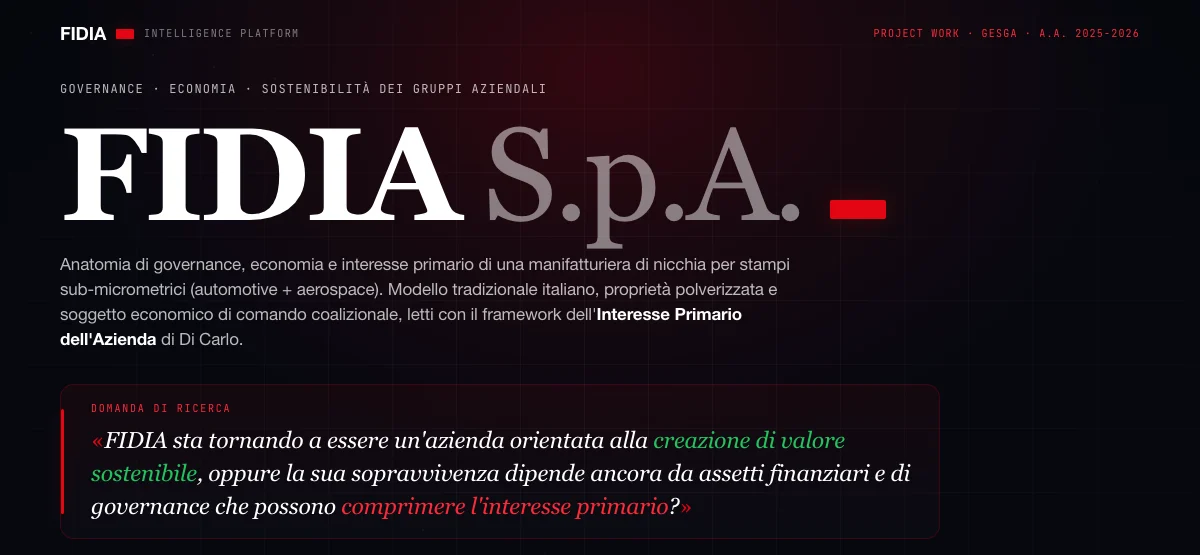
35 screens · interface in Italian
- 01Open a figure
Tap a source label: see the document, section and page.
- 02Rotate the ADEF cube
Part II: the group’s companies on three dimensions.
- 03Ask a question
The assistant at the bottom right answers as the company.
A — The problem
The Governance, Economics and Sustainability of Corporate Groups course asked us to apply theory to a real case, not just describe it. Slides flatten everything: relationships between companies, economic balances and sources end up in lists that are hard to check.
B — What I built
I analysed the FIDIA group from its public documents and built a web platform instead of a slide deck: 35 screens in three parts — governance and actors, the business group, primary interest — with interactive models instead of static charts. Every figure cites its document, section and page. An AI assistant answers questions speaking as the company, and an independent check reviews every answer before it is shown.
C — How it works
- 01
Theory comes first
Each screen starts from a concept from the course — the company as a person, the group as a system, the four balances — and only then brings in the case figures.
- 02
Sources one click away
A structured dataset links every figure to the original document: clicking the label opens the exact citation.
- 03
Models you can touch
A 3D cube classifies the group’s companies on three dimensions; a tetrahedron shows how the four balances move from 2021 to 2025.
- 04
An assistant with a guardian
The AI consults the material and answers; a second check reviews the answer and, when needed, points to the human body that should decide.
D — The system
A simplified map of the components: not the technical documentation, but it shows how the parts talk to each other.
E — Why it works
No figure without a source
Traceability lives inside the interface, not in a bibliography at the end.
35 screens, not a deck
You move through the parts with the keyboard or menu, and dig deeper where it matters.
3D where it actually helps
The ADEF cube makes a three-axis classification visible; on phones it becomes a pair of 2D matrices.
AI supports, people decide
The assistant helps people think; responsibility stays with the governance bodies.