Personal project · app · 2026
Splitro
Who paid for fuel? Splitro splits car-trip costs between friends, starting from a sentence written the way you’d say it.
live demo Original app + simulated bot
Sample group: names and trips stay on your device. Payments and AI chat are not active in the demo.
01 Original app · real splitting engine
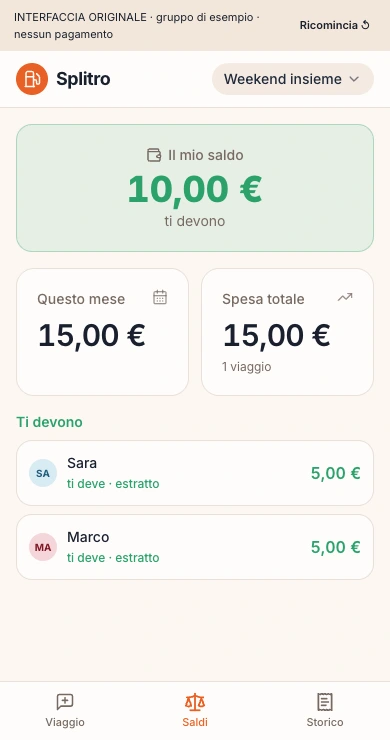
Original React interface, sample group and real cost allocation. New trips are kept only for this demo session. The original app is in Italian.
Open the app full screen ↗02 Telegram bot · how a sentence becomes a trip
- 01 · The AI reads the sentence
Waiting for a message…
- 02 · Code does the mathsNo calculation yet.
- 03 · You confirm
Nothing is saved without your tap on “Confirm”.
The AI works out who was there, how much and when. The shares are computed by code, in whole cents: they always add up to the total, even when the numbers aren’t round.
A — The problem
On shared trips the maths gets lost: one tank each, the driver who doesn’t pay, half-settled refunds. Expense apps ask you to fill in forms, and in the end nobody does.
B — What I built
Splitro works as a Telegram bot, a web app and a mini app. Write “60 tank, me, Marco and Anna, I was driving”: the AI interprets the sentence and proposes the trip, but the shares are computed by code, to the cent. Balances and history always show who owes what to whom.
C — How it works
- 01
Type or dictate
One sentence, even a voice note.
- 02
A proposal to confirm
The bot shows the trip with participants and shares; you confirm with a tap.
- 03
To the cent
Integer cents: the shares always add up to the total.
- 04
Clear balances
Who owes whom, and how much, on one screen.
D — The system
A simplified map of the components: not the technical documentation, but it shows how the parts talk to each other.
E — Why it works
AI reads, code counts
The model understands the sentence; a deterministic function handles the money.
Three interfaces, one backend
Telegram, web and mini app share data and rules.
Group habits
Recurring rules like “the driver doesn’t pay” apply automatically.
A real demo
Below you’ll find the original interface with the real splitting engine.